Read the article as text
The Time Taken is The
Time Taken
Your Guide to Better Billing & Results
by Jay Sahota
www.masalamentor.co.uk

              The time taken is the time taken
£73,343.
That is the average additional cash billed per fee earner, per year, after my workshops.
No one needs to work longer hours and no one needs to hire more people.
A large slice of it comes from one unglamorous place: the time that was given away
before it ever reached a bill.
Most firms don’t have a billing problem because their people are slow but because
their people reduce their own time before anyone else ever sees it.
A fee earner spends 40 minutes on an email, decides it “feels like a lot”, and records
20. Another rounds a complex letter down to a single unit, out of habit. A third sees
that the work has run over the estimate and shaves the difference to keep the client
sweet.
None of it is dishonest. All of it is expensive.
I call it self-sanitising. Reducing the time before it is even recorded. It is the most
costly habit in most law firms, and the most invisible, because the figure was never
written down in the first place. You cannot recover what you never captured.


Here is what good looks like:
Record all of it
The starting position is simple. You record all of the time taken. The full amount, not a
tidier version that happens to sit inside the estimate or spare the client an awkward
conversation.
A fee earner has no discretion to record less time than was actually spent. That is not
a licence to be slow or careless. It is a recognition that accurate time data is the firm’s
lifeblood.

                                 www.masalamentor.co.uk

The moment people pick and choose what to record, the firm loses the one thing it
needs to price and plan: the truth about where the hours go.
If there is a genuine reason to record less, that is a decision for a director. It is not a
habit for a Tuesday afternoon.
The time taken is the time taken
This is the line I come back to most.
An email is charged at the time it took to draft, not a flat unit. A short
acknowledgement is one thing. A considered letter that took half an hour is half an
hour.
It is also not about how you feel about the work. Whether you think it took too long.
Whether you suspect it was beneath your grade. None of that changes what actually
happened on the clock. If the work has outgrown the estimate, revise the estimate.
The time sheet is not where you fix a quote.


What counts as chargeable?
The default is simple. You record every action that
contributes to the matter. The only things that
usually sit outside are pure administration and
business development.
The work people most often miss goes back on the
clock. Costs queries, as distinct from a complaint,
are chargeable in full. So is the time spent
considering and drafting case notes. Any non-minor
piece of invoice drafting, file opening, engagement
letter, AML work or file closing is chargeable too.
Routine AML below that threshold can sit on a small
fixed charge, but it does not disappear.
If you are unsure whether something is chargeable,
the answer is almost never to leave it off. Ask a
director.


                                www.masalamentor.co.uk

                 One quick mechanic: As a rule of thumb, record in units for
                 tasks separated by time, and in minutes for a continuous block
                 of work. That keeps the record honest without turning every
                 entry into a maths exercise.


Record it the same day, then read your own day back
Time should be recorded as you go and entered by the end of the day. Memory is not a
billing system. The longer the gap, the more time leaks.
There is a second reason and it matters more than the first. By the end of the day you
should be able to look at your own entries and understand how the day was actually
spent.
That is where efficiency comes from. That is where you spot the task that keeps
running over, or the matter that is silently losing money, or the area where you could
use some help.


    You cannot improve a day you cannot see.
    1. Set a chargeable-hours floor
    Once you can see your day, you can hold it to a standard.
    2. Set a daily floor for chargeable hours and review it every month. For many
    full-time fee earners that floor sits at around four hours, with the rest of the
    day going on work that genuinely cannot be charged.
    3. Record on fixed fees too
    This is the one people resist. If the fee is fixed, why record the time?
    Because a fixed fee is only sensible if it is profitable, and you cannot know
    whether it is profitable unless you know what it costs to deliver. A fixed fee
    you never measure is just a guess wearing a suit.
    Record the time. Then you can see which fixed fees work, which need
    rescoping, and which you should never have offered at that price.


                              www.masalamentor.co.uk

    4. Take behaviour into account When quoting, take into account factors such
    as client behaviour, past estimates, how long such work typically takes, what
    caused it to be out of kilter last time - then adjust the quote accordingly”


The real fix is upstream
Most of the pressure to reduce time comes from a single source. A quote that was
wrong, left unmanaged until it was too late to do anything but absorb the difference.
The discipline that actually protects your margin sits before the work.
Estimate properly in the first place. Use the 1234. Scope the matter so you have room
to charge for additional work when it arrives, rather than swallowing it. Build cushions
into an hourly estimate. Get the fixed fee right before you commit to it.
Then watch it. Keep an eye on time against estimate, and use the 75% marker as your
early warning. When you reach 75% of the time you quoted, that is your prompt to
act, while you still have options.
When the time still runs over, the move is always the same. You go back to the client
and ask them to approve the difference, set out as a revised estimate or an increased
bill, with the value spelled out. The magic wording is built for exactly that moment.


                               www.masalamentor.co.uk

How you get there depends on the type of work:
On a fixed fee, the fee has to be right at the outset, which is the 1234 again, and
scoped so you can charge for additional work within reason. Have a conversation with
a director when you reach 75% of the time the fee represents, well before you hit
100%. Then take the value conversation to the client.
On hourly work, your estimate should already carry the right factors and cushions.
Review at 75%. Work inside the triangle. If you are past that point and the time has
overtaken the estimate, go to the client, explain why the work grew, and ask them to
approve the difference.
Before that call, look back at the attendance note for each triangle call and each
estimate, and work out what went wrong. If you misquoted, understand why, so the
same mistake does not happen again. If the client will not approve it, or approves only
part, a small capped write-off is the genuine last resort.
Anything beyond that goes to a director.
A fixed-fee meeting is its own case. Scope it properly and be honest about preparation
time, the meeting itself, and anything that follows it. The fee covers the meeting, not
the written advice or extra documents that come out of it. If you find yourself more
than 20% over the time the fee assumes, stop and refer it up.


All time recorded must be billed.
Work in progress is not shaved, and neither is the bill, without a director’s express
permission. That sounds firm because it has to be.
Every write-down, every discretionary trim, every “I’ll just knock a bit off” is the firm’s
profit walking out of the door one small decision at a time.
On its own, none of it looks like much.
Across a year and a team, it is the difference between a firm that works hard and a
firm that gets paid for working hard.
Better billing = Better results


                                  www.masalamentor.co.uk

Better billing is rarely about working longer or harder. It is about stopping the leaks.
Capture the time honestly. Record it the same day. Price and scope properly at the
start.
Manage the estimate at 75%, not at 110%. Have the awkward conversation early,
while it is still an easy one.
Do that and the time recording looks after itself. So does the profit.
Where is your firm subconsciously giving time away before it ever reaches a bill?


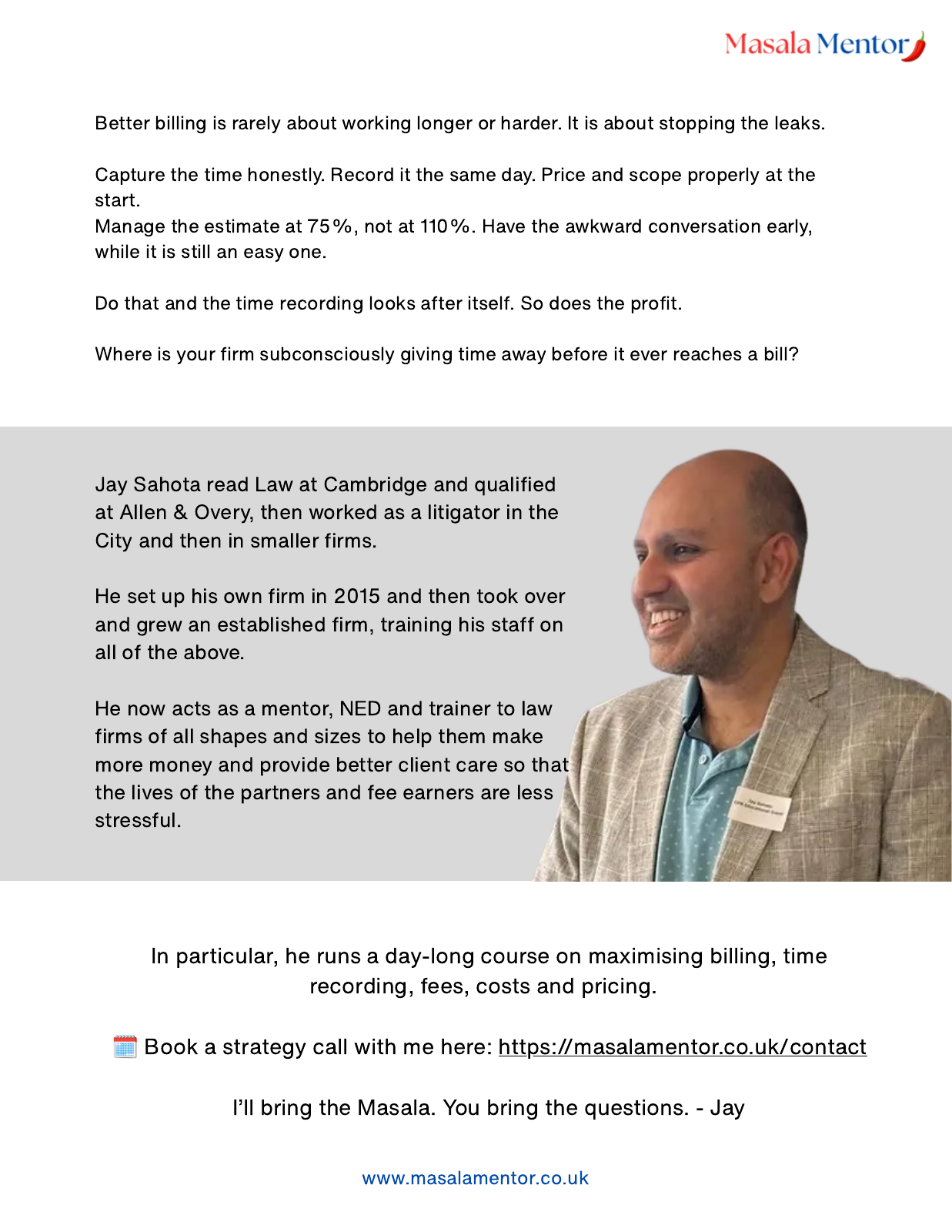
Jay Sahota read Law at Cambridge and qualified
at Allen & Overy, then worked as a litigator in the
City and then in smaller firms.
He set up his own firm in 2015 and then took over
and grew an established firm, training his staff on
all of the above.
He now acts as a mentor, NED and trainer to law
firms of all shapes and sizes to help them make
more money and provide better client care so that
the lives of the partners and fee earners are less
stressful.


      In particular, he runs a day-long course on maximising billing, time
                       recording, fees, costs and pricing.
 🗓️ Book a strategy call with me here: https://masalamentor.co.uk/contact
                I’ll bring the Masala. You bring the questions. - Jay

                                www.masalamentor.co.uk