
 Maria Morris

The nature of work is changing rapidly. This article explores the future role of vocational evidence in UK law.
5. The Psychology of Work: Why Medical Evidence Is Not Enough
Medical experts:
– Identify the diagnosis
– Understand the symptoms
– Assess the impairments
Vocational experts answer questions such as:
– How the condition affects work capacity ?
– Which tasks can realistically be sustained?
– Whether the working environment is suitable?
– Which workplace adjustments may be required?
– Roles that can be realistically done?
– The level of earnings that may still be achievable
This distinction is critical.
A person with chronic pain may be able to sit, stand, and walk — but not for long enough to sustain full-time employment.
Someone with ADHD may be highly intelligent — but unable to cope with high pressure deadlines or more unstructured or chaotic environments.
PTSD sufferers may be physically capable — but unable to tolerate customer facing roles due to added potential for stress or conflict.
Vocational experts integrate functional, psychological, and occupational evidence into a coherent whole.
6. The Rise of Neurodivergence, Long Covid & Complex Conditions
The modern labour market is seeing a surge in health conditions as detailed below
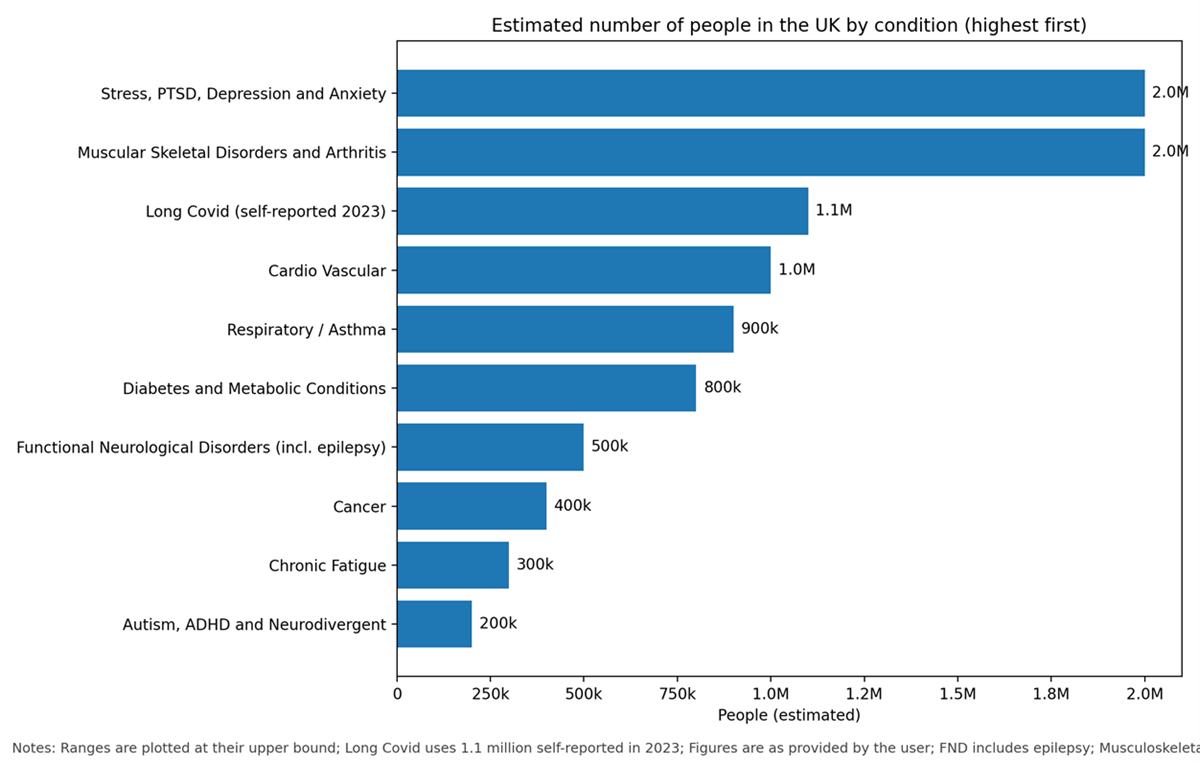
Graph created using Microsoft CoPilot from researched data:
Health conditions and symptoms require vocational expert nuanced understanding on any potential for work.
It is of concern to note that in 2023, working age adults reported a health limited condition rising from 15 to 20%. Plus 4 million people were economically inactive (an increase from 3.2million in 2013) due to ill health. People reporting ill health had 5 or more conditions.
It is also important to note that neurodiversity diagnosis is increasing. According to React Neurodiversity, JobSearch and Work Report 2024, one in ten people are considered to have neurodivergent symptoms. www.gov.uk states that “ Just 31% of people with a neurodiversity condition in employment compared to 54.7% of disabled people overall”
Vocational experts consider:
– Cognitive load
– Sensory demands
– Executive functioning
– Fatigue management
– Environmental triggers
– Adjustment needs
– Feasibility of hybrid or remote work
This is often far beyond the remit of most medical or other experts.
7. What Happens When a Vocational Expert Is Not Used
The consequences can be significant including…
Under compensation of claimants because courts or Tribunals may underestimate the impact of injury or illness on employability.
Over-compensation of claimants as Courts or Tribunals may assume a person cannot work when they can.
Unfair spousal maintenance orders whereby one party may be expected to earn more than is realistic.
Misinterpretation of medical evidence because medical reports do not translate directly into vocational outcomes.
Incorrect assumptions about labour market opportunities as Courts or Tribunals may assume jobs exist that do not.
Failure to understand neurodivergent, psychological or more complex health conditions and their barriers to work. This can lead to harsh or unrealistic expectations.
Increased litigation risk whereby lack of vocational evidence leaves decisions vulnerable to challenge.
Vocational experts reduce these risks by providing objective, evidence and experience-based clarity.
8. The Future of Vocational Evidence in UK Law
Given the Circle Vocational experience and our research, the need for vocational experts will continue to increase. The reasons for this are as follows:
The labour market is changing rapidly as automation, AI, hybrid work, and skills shortages mean employability is more complex than ever.
Courts and Tribunals are increasingly expect evidence, not assumption. They require detailed, functional, evidence driven assessments from a vocational expert.
Neurodivergence and mental health conditions are rising which require specialist vocational interpretation.
Long Covid is creating new patterns of disability and Vocational experts are essential in understanding its long term impact.
Hybrid and remote work have transformed job feasibility whereby Vocational experts can map realistic opportunities.
The legal system is becoming more interdisciplinary. Courts and Tribunals now expect integration of medical, clinical, therapy, psychological, occupational, and labour market evidence. Vocational experts are uniquely positioned to provide this.
In Conclusion: The Vocational Expert as the Court’s Guide Through Complexity
In a world where work is evolving faster than ever, vocational experts have become indispensable. They provide the bridge between medical or clinical and therapeutic evidence, personal history, functional capacity, transferable skills plus labour market reality.
Across personal injury, family law, employment law, and tribunal litigation, vocational experts ensure that decisions about earning capacity, employability, and future employment or job prospects are grounded in evidence, not assumption.
They protect claimants from under compensation, protect defendants from overcompensation, support fair spousal maintenance decisions, clarify complex employment disputes, reduce litigation risk, bring objectivity to emotionally charged cases and help courts or Tribunals to navigate the realities of modern work.
In summary, Vocational experts are the hidden architects to provide fair outcomes. They can be instructed as a single, joint or single joint expert. They provide specific opinion and evidence about that client not just a client who works in an office, as a Nurse or in any other job role. Vocational experts help to triangulate information making it specific to that individual.
Not only do vocational experts help the legal system. They can help guide recommendations to enable people who are able to work to do so with impact on our economy. The core of our population, of working age, and a total of 6.5million people are either in work with a health limiting condition using adjustments or out of work due to long term sickness.
In my opinion and experience, as the labour market continues to evolve, the vocational expert role will only become more central to the pursuit of justice.
Maria Morris is available for instruction across the U.K, to request her C.V or discuss your Expert requirements, please email expert@circlecm.com or call 0129724145. Find out more about Circle Case Management by visiting www.circlecasemanagement.com
References within the article can be found below.
Reference List
A Local Authority v RS (Capacity) [2020] EWCOP 29. (2020). Court of Protection. Available at:AA Local Authority v RS (Capacity) | [2020] EWCOP 29 | England and Wales Court of Protection | Judgment | Law | CaseMine
The Impact of Case Law on Vocational Expert Examinations and Opinions in Marital Dissolution- Lynne Tracy and Ann Wallace. www.scholasticahq.com
Civil Procedure Rules (CPR) Part 35. (n.d.). Expert Evidence. Available at: https://www.justice.gov.uk/courts/procedure-rules/civil/rules/part35 .
Family Procedure Rules (FPR) Part 25. (n.d.). Experts and Assessors. Available at: https://www.justice.gov.uk/courts/procedure-rules/family/parts/part_25.
VARSS Scotland – Vocational Assessment & Rehabilitation Services. (n.d.). Vocational Assessment and Functional Capacity Evaluation. Available at: https://www.varss.co.uk
Doherty Stobbs Ltd. (n.d.). Vocational Expert Witness Services. Available at: https://www.dohertystobbs.co.uk
NHS Resolution. (n.d.). Claims Management and Use of Expert Evidence. Available at: https://resolution.nhs.uk
ACAS. (n.d.). Reasonable Adjustments and Disability Discrimination Guidance. Available at: https://www.acas.org.uk/reasonable-adjustments
Equality Act 2010. (2010). UK Public General Acts. Available at: https://www.legislation.gov.uk/ukpga/2010/15/contents
Employment Tribunals (Constitution and Rules of Procedure) Regulations 2013. (2013). UK Statutory Instruments. Available at: https://www.legislation.gov.uk/uksi/2013/1237/contents/made
Office for National Statistics (ONS). (n.d.). Labour Market Overview. Available at: https://www.ons.gov.uk/employmentandlabourmarket
Department for Work and Pensions (DWP). (n.d.). Work Capability and Employment Support Guidance. Available at: https://www.gov.uk/government/organisations/department-for-work-pensions
Health Foundation and ONS data analysis of UK Employment
CIPD Neurodiversion at Work Report 2024: Neuroinclusion at work report 2024
React Neurodiversity, JobSearch and Work Report 2024- Claudia Plowden Roberts and Zofia Bajorek. REPORT Neurodiversity, jobsearch and work.pdf
Maria Morris is available for instruction across the U.K. To request her C.V or discuss your Expert requirements, please email expert@circlecm.com or call 0129724145.
This article is article 4 of 4. This article forms part of a wider series on vocational evidence in UK law. The previous articles in this series are below:
The Role of Vocational Experts in Modern Litigation
Personal Injury & the Risk of Getting it Wrong Without Vocational Evidence
Vocational Evidence in Family Law and Employment Tribunals
FAQ’s
What does a vocational expert do in UK legal cases?
A vocational expert assesses how injury, illness, disability, neurodivergence, or other personal circumstances affect a person’s ability to work, earn income, retrain, or return to employment. Their role is to provide evidence-based analysis on employability, earning capacity, transferable skills, workplace adjustments, and labour market realities across areas such as personal injury, family law, employment law, and tribunal litigation.
Why is medical evidence alone often not enough?
Medical evidence explains diagnosis, symptoms, and impairment, but it does not usually determine how those issues affect real-world employment. Vocational experts bridge that gap by analysing how physical, psychological, or cognitive conditions impact work capability, realistic job options, future earnings, retraining potential, and workplace adjustments.
In which types of legal cases are vocational experts used?
Vocational experts are increasingly instructed in:
- Personal injury litigation
- Employment Tribunal claims
- Family law and divorce proceedings
- Disability discrimination cases
- Long-term sickness and capability disputes
- Cases involving neurodivergence or mental health conditions
Their evidence helps Courts and Tribunals assess employability, future earnings, reasonable adjustments, and realistic work capacity.
How can vocational evidence affect compensation or financial settlements?
Vocational evidence can significantly influence compensation and financial outcomes by helping Courts or Tribunals understand:
- Loss of earnings
- Future earning capacity
- Ability to return to work
- Retraining feasibility
- Labour market opportunities
- The long-term impact of injury or illness on employment
Without vocational evidence, decisions risk being based on assumption rather than objective analysis.
Why is vocational evidence becoming more important in modern UK law?
Modern working life has become increasingly complex due to factors such as hybrid working, AI, Long Covid, mental health conditions, neurodivergence, and changing labour market expectations. Courts and Tribunals now increasingly expect evidence-based assessment rather than speculation when considering employability and earning capacity. Vocational experts provide the specialist analysis needed to interpret these modern workplace realities.