

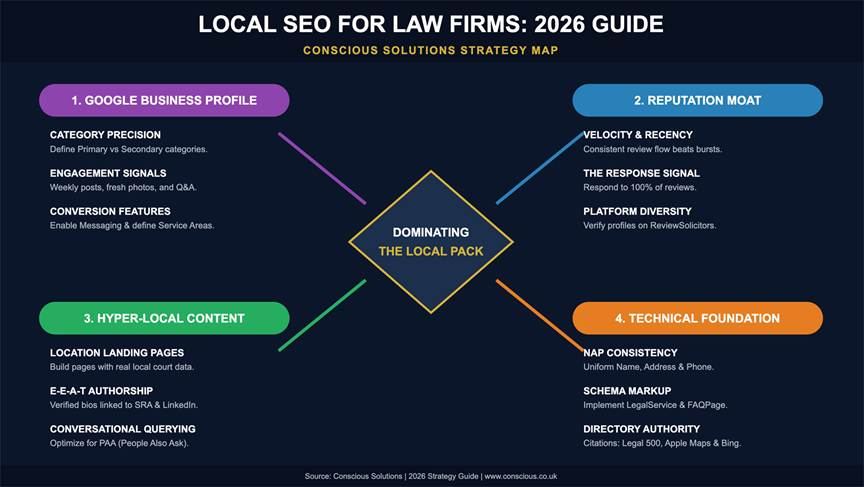
This is the first part of a four-part series from Conscious Solutions which breaks down Local SEO for Law Firms in 2026 and explores why local SEO remains one of the strongest digital marketing channels for UK law firms in 2026. It focuses on the shift away from broad informational content toward conversion-led local authority and introduces the foundations of modern legal SEO strategy.
1. Introduction: The Defensible Advantage of Local SEO
To build local SEO authority and rankings for UK law firms in 2026, you must pivot from traditional “made-for-search” tactics toward a conversion-led KPI strategy that emphasises brand trust, AI visibility, multi-media diversification and off-platform signals.
As AI Overviews (AIO) and zero-click searches reduce traffic to top-of-funnel informational blog posts, local SEO for law firms remains the most defensible and high-converting digital asset for the UK legal industry. Unlike broad informational content, locally optimised service and contact pages, a robust Google Business Profile, and local insights and case studies cannot be summarised away by an AI.
2. The Strategy: Conversion-Led Local Authority
Traditional informational blog posts are losing visibility as Google’s AI Overviews answer top-of-funnel questions directly on the search page. The 2026 local SEO strategy for UK law firms and solicitors, must focus on:
- High-Intent Practice Pages: Instead of broad guides (e.g., “What is a Will?”), focus on high-intent, location-specific service pages (e.g., “Will Writing Solicitors in Bristol”). These pages must serve commercial and transactional search intent and should be the primary investment of your content resource.
- Conversion-Optimised Design: Mobile-first web design containing optimised conversion signals in the first fold – the images, calls to action and trust signals must be immediately visible without scrolling.
- Niche “Super-Serving”: Law firms should super-serve narrow legal niches (e.g., “High-Net-Worth Divorce in London”, or “Local Property disputes in Bristol, 2026 Guide) to build a specialised brand that AI cannot easily generalise. Depth of expertise on a narrow topic is now more valuable than broad coverage.
- AEO & GEO (Answer Engine & Generative Engine Optimisation): Optimising for Answer Engine Optimisation (AEO) and Generative Engine Optimisation (GEO) involves using structured data, headings and concise expert question-and-answer legal summaries, alongside local expertise that AI agents can cite in conversational results.
- Reputation-Led Conversion: You cannot afford to waste a conversion. Negative reviews and poor first impressions will directly reduce your conversion rate. Audit your client journey end-to-end – from the initial enquiry call to onboarding. Train receptionists, set response time targets, and treat every review as a data point.
- Core Web Vitals as a Local Ranking Pre-Requisite: In 2026 your website cannot have speed issues or conversion friction. Ensure LCP is under 2.5s, INP under 200ms, and CLS under 0.1 using CrUX field data from Google Search Console – not just lab scores. These thresholds are verified against the Chrome User Experience Report (CrUX).
3. Google Business Profile & Engagement Signals
Your Google Business Profile (GBP) is the primary driver of local pack rankings, accounting for approximately 32% of the ranking weight according to the 2023 Local Search Ranking Factors survey (Whitespark / BrightLocal). It is also one of the few channels where optimisation delivers results without any technical development resource.
- Primary Category: This remains the number one individual ranking factor. Your primary category (e.g., “Solicitors,” “Divorce Lawyer,” “Law Firm”) must be precise and reviewed annually. The size of your practice, the number of services offered, and your most profitable income stream should inform this decision. There is no universal best answer.
- Secondary Categories: Add all relevant secondary categories (up to 9) to cover your full practice area breadth (e.g., “Family Lawyer,” “Conveyancer,” “Employment Attorney”). Secondary categories increase surface area for non-primary queries.
- Active Engagement: Google rewards freshness. Firms must publish weekly GBP posts, add new photos regularly (office exterior, interior, and team headshots), and use the Q&A section to address common client enquiries proactively.
- Behavioural Signals: Clicks to call, requests for directions, and dwell time on the listing are increasing in importance as ranking signals. Optimise your listing copy and imagery to encourage these actions.
- Proximity vs. Authority: While proximity to the searcher is a major ranking factor, solicitors can override this disadvantage by building higher prominence through citations, reviews, and on-page authority.
- Complete Profile: Ensure your profile is marked 100% complete. Incomplete profiles are deprioritised in competitive map pack results.
- Accurate Map Placement: Confirm your map pin is correctly placed at your physical office entrance. Incorrect placement reduces direction requests and erodes trust.
- Products & Services Section: Populate the Products and Services sections in full. These fields are indexed and provide additional keyword surface area beyond your business description.
- GBP Messaging: Enable the messaging feature and assign a team member to monitor it. Google displays response time data publicly. A slow or absent response rate is visible to potential clients and harms conversion.
- UTM Tracking on GBP Website Link: Append UTM parameters to your GBP website URL (utm_source=google&utm_medium=organic&utm_campaign=gbp) so GA4 correctly attributes GBP-driven sessions rather than misclassifying them as direct traffic.
- SRA Number in GBP Description: Include your SRA registration number in your GBP business description. This is a direct trust signal for prospective clients and a supporting E-E-A-T indicator for Google’s quality algorithms on YMYL legal content.
- Service Area vs. Physical Location: If you are a solicitor who serves clients beyond your immediate locality without requiring office visits (e.g., remote conveyancing), use the Service Area feature to expand your map pack eligibility. Do not set a service area and a physical address simultaneously if you serve customers at your premises, as this can suppress local pack visibility. Also beware penalties from overlapping service areas. Google often punishes those overlaps with suspensions.
GBP Optimisation Checklist
Use this checklist to audit every office location.
| Optimisation Task | Source / Tool | Priority |
| Primary category set (Solicitors / Law Firm) | GBP Dashboard | Critical |
| Secondary categories added (e.g., Family Law, Conveyancing) | GBP Dashboard | High |
| Business description (750 chars, keyword-rich) | GBP Dashboard | High |
| NAP matches website and all citations exactly | GBP / Screaming Frog | Critical |
| Map pin verified and correctly placed | GBP Dashboard | Critical |
| Opening hours complete (incl. bank holidays) | GBP Dashboard | High |
| At least 10 photos (exterior, interior, team) | GBP Dashboard | High |
| Products / Services section populated | GBP Dashboard | High |
| GBP posts published weekly | GBP Dashboard | Medium |
| Q&A section pre-populated with FAQs | GBP Dashboard | Medium |
| Messaging feature enabled and monitored | GBP Dashboard | Medium |
| Review responses in place for all reviews | GBP Dashboard | Critical |
| SRA number referenced in GBP description | GBP Dashboard | High |
| Service areas defined (if no walk-in premises) | GBP Dashboard | High |
| Website URL points to location-specific page | GBP Dashboard | High |
| UTM parameters on GBP website link (GA4 tracking) | GBP / GA4 | Medium |
Part 1: Conclusion
Part 1 establishes the strategic foundation for local SEO success in 2026. The focus is no longer on generating maximum traffic at any cost, but instead on attracting high-intent enquiries through authority, trust, conversion optimisation and local relevance.
FAQ’s
1. Why are traditional informational legal blogs losing visibility?
The article explains that AI Overviews and zero-click searches are reducing traffic to broad informational legal content.
2. What type of pages should law firms prioritise in 2026?
The guide recommends focusing on high-intent, location-specific service pages designed to convert enquiries.
3. Why is Google Business Profile so important for solicitors?
According to the article, Google Business Profile remains one of the strongest local ranking factors and a major driver of map pack visibility.
4. What are AEO and GEO in legal SEO?
The article discusses Answer Engine Optimisation (AEO) and Generative Engine Optimisation (GEO) as strategies for improving visibility in AI-driven search results.
5. How do Core Web Vitals affect local SEO rankings?
The guide highlights website speed, responsiveness and stability as essential ranking prerequisites for law firms in 2026.